
Baseloop Reverse email lookup API pricing
Is Baseloop yours? Write to us about this page. We invite selected tool providers to our WhatsApp group.
- FreeFree trial$0.00 per 1,000
- €149 monthlyStarter$335.339 per 1,000
- €499 monthlyPro$336.915 per 1,000
- €1,399 monthlyMax$314.859 per 1,000
- €1,608 yearlyStarter (annual)$301.58 per 1,000
- €5,388 yearlyPro (annual)$303.156 per 1,000
- €15,108 yearlyMax (annual)$283.351 per 1,000
- Contact usEnterprise
- Docs behind sign-upFree$0.00 per 1,000many emails in one call
- Baseloop email finder API
- Baseloop phone finder API
- Baseloop reverse email lookup API
- Baseloop LinkedIn company data API
- Baseloop LinkedIn profile API
About this item
- Freshness. We don't know how fresh this plan's data is.
- 1 of the 13 fields on our checklist. Experience.
- Nothing to pay. You get 100 credits once, enough for about 33 calls. Unused credits expire after 7 days.
- One call. Baseloop shows the call's docs once you sign up. The call returns a job. You fetch the answer once the job is done.
- Who can get it: anyone, no card required. Keep data: with conditions. Use data: with conditions.
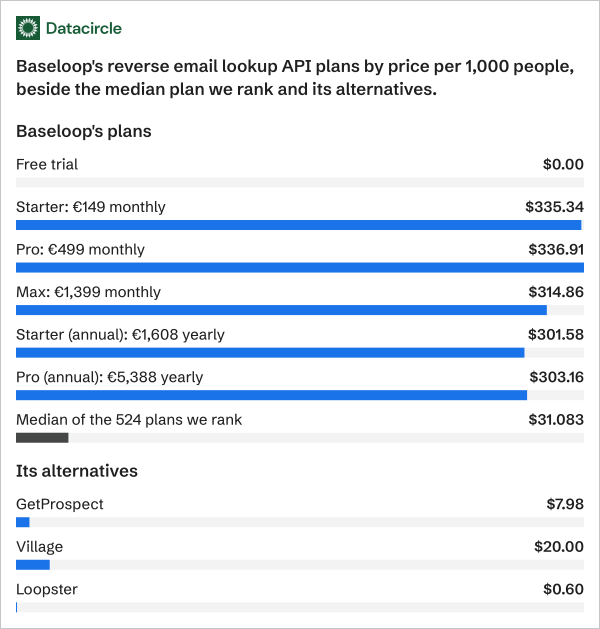
Baseloop: reverse email lookup API alternatives
Baseloop alternatives: every reverse email lookup API provider ranked
The table starts with Baseloop's cheapest paid plan. Next come plans from other providers with the price per 1,000 people closest to Baseloop's.
| Baseloop, €15,108 yearly | BigEasyData, $1,000 monthly, Agency Plan | OSINT.SX, $1,000 pack | ZoomInfo, $8,700 pack | KingMinos, pay as you go | |
|---|---|---|---|---|---|
| $ per 1,000 people | $283.351 | $285.714 | $285.714 | $290.00 | $300.00 |
| Completeness | 8% | 23% | 15% | 38% | 0% |
| Billing | yearly | monthly | pay first | pay first | pay as you go |
| Pay | €15,108 | $1,000 | $1,000 | $8,700 | monthly |
| Enough for | 60,000 calls a year | 3,500 calls a month | 3,500 calls | 30,000 results | as many as you pay for |
| Freshness | unknown | unknown | live | stored | unknown |
| Who can get it | businesses: the entity on whose behalf the individual signs up | anyone | anyone 18 or older | employees of the company that holds the account (a contractor only with ZoomInfo's prior permission), each with their own login and a business email address | anyone for business use, aged 18 or older and able to bind the customer (the Service is for business use only) |
Questions about Baseloop reverse email lookup API
Is Baseloop reverse email lookup API free?
Yes: Baseloop reverse email lookup API has a free plan. The Datacircle price sheet lists 8 Baseloop reverse email lookup API plans.
How much does Baseloop reverse email lookup API cost?
This plan of Baseloop reverse email lookup API is free.
Baseloop reverse email lookup API has 8 plans on the Datacircle price sheet: free, then from €149 monthly.
What does Baseloop reverse email lookup API return?
Baseloop reverse email lookup API returns full name, first name, last name, LinkedIn URL, job title and company name.
What are the alternatives to Baseloop reverse email lookup API?
The Datacircle price sheet compares Baseloop reverse email lookup API with BigEasyData, OSINT.SX and ZoomInfo.
Baseloop alternatives: every reverse email lookup API provider ranked.
Sources
From each provider's own pricing page and docs, and from what providers tell us. We read this row from these pages on 2026-11-24.
Product details
We check 13 data fields on each person. We put a ✓ on each field Baseloop returns. Below the fields, you see the plan's price and terms.
- Experience
- Education, not in the answer
- Skills, not in the answer
- Headline, not in the answer
- About, not in the answer
- Location, not in the answer
- Photo, not in the answer
- Followers, not in the answer
- Connections, not in the answer
- Certifications, not in the answer
- Languages, not in the answer
- Recommendations, not in the answer
- Open to work, not in the answer
| $ per 1,000 people | $0.00 |
|---|---|
| Per | call |
| Billing | free |
| Aggregators | none |
|---|
| Also pays for | from the same budget: Waterfall email enrichment · Waterfall phone enrichment · Enrich contact · Enrich company |
|---|
| $ per 1,000 people | $101.277 |
|---|
| $ per 1,000 calls that find nothing | $0.00 |
|---|
| Their pitch | Find the person behind an email address: name, profile URL, title, and company. |
|---|
| Keep data | until the Agreement ends: on termination Customer shall “destroy or return any Company IP”, which includes “any data and information made available by Company through the Platform” |
|---|---|
| Use data | [...] access and use the Services for Customer’s internal business operations during the Subscription Term, in accordance with any Usage Limitations. Customer shall not, and shall not permit any Authorized User or third party to: (i) copy, modify, or create derivative works of any Company IP, (ii) resell, lease, sublicense, or distribute the Services to any third party, (iii) reverse engineer, decompile, disassemble, or otherwise attempt to derive source code from the Platform or Client-Side Software [...], (iv) remove any proprietary notices from the Services, (v) use the Services in violation of Applicable Laws or in a manner that infringes any third-party rights, (vi) use or attempt to use the Services to build a competitive service, (vii) transmit malicious code or engage in any action that disrupts or interferes with the performance or security of the Services, or (viii) exceed any Usage Limitations. |
| Pay | €0 |
|---|---|
| You get | 100 credits |
| Enough for | about 33 calls, once |
| Expires | 7 days |
| Per day | 50,000 |
|---|---|
| Per second | 33.33 (2,000 a minute) |
| Answer | by polling |
|---|---|
| Median | 52.21 s |
| You send | Docs behind sign-up |
|---|
| Plan | Free trial |
|---|---|
| Who can get it | anyone, no card required |
The 6 fields the plan's answer can hold
full name, first name, last name, LinkedIn URL, job title, company name